Showing posts with label Plant info. Show all posts
Monday, April 30, 2012
Gardening Weather at Last!
Down the side of my driveway is a gap to the fence of no more than 15cm, as deep as the slab. The gap had nothing in it at all except weeds, and I thought I had no soil to put in it until I remembered the unused planter box mix sitting in a heap near my Hill's hoist. We weeded, then I barrowed the planter box mix to the driveway and the kids swept it into the gap. When we were uncovering the mix, we found a nest of blue ants with their eggs.
At every fence-post, the Sprig planted Dietes grandiflora, which I had divided from a clump in the front garden. The clumps are shallow-rooted in my clay soil but were very hard to dig out because the clump was a good half-metre across. Dividing the clump took a while too as I hadn't tried it before. Dietes is a great plant for Sydney, growing in a slow-spreading clump of strappy leaves to 60cm and requiring no attention whatever. The flowers are of the iris type, with a purple 'cup' over a wide white 'saucer'. Unfortunately, these wilt quickly when cut.
At the shady end of the long bed, the Sprig strewed forget-me-not seeds. I popped in a Pelargonium where we will see it from our family-room window, then planted rooted segments of Coleus amboinicus up at the sunny end. Near our pond garden, I found a baby Erigeron karvinskianus growing, and I've transplanted this to the driveway bed too.
The native violets I bought the other day (with the sweet peas and bugle flower) has gone under the little bracelet honey-myrtle by the pond. The sweet peas are planted around two tetrapods in the herb bed. I've also planted the blugle flower there. I have a feeling it is Ajuga reptans 'Cavalier' rather than the Ajuga reptans purpurea on the label: the cultivars were mixed in together and mine has large purple leaves rather than small ones. I thought the Ajuga would look good next to the Echium because of the contrast in foliage, and I do hope the bloom periods overlap: the bugle flowers are the same shape and colour as the Echium's, just much smaller.
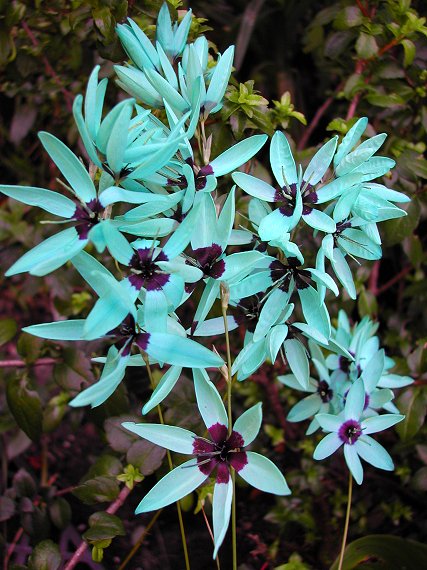
Ixia viridiflora are a turquoise colour with a purple-black central eye, so I thought they'd go well with my mallard-green pergola. I've planted them around the bugle flower. There are now half a dozen Allium 'Drumstick' bulbs at the back of the herb bed too.
The peacock flower, Moarea aristata, has snow-white petals with a navy-blue stain at the base. I thought they'd look nice near my rosemary (which has a deep blue flower) and marjoram. At the other end of the bed, I have planted deep velvety purple Sparaxis so one day they will flower near a pineapple sage (not yet purchased).
Then I've started a row of 'Greenfeast' peas near my washing line and am soaking some snow peas for planting on one of my tetrapods in the herb bed. The other tetrapods have sweet peas around them. The only harvest in prospect is of small tomatoes, but they are delicious!
Labels:
Extension,
Garage bed,
Herb bed,
My garden,
Plant info,
Vegetables
Friday, December 23, 2011
Bog Garden Planted
Below are some typical bog plants for this part of the world.
Dianella longifolia, the Pale Flax-Lily, which has beautiful blue berries:
Isolepsis nodosa, the Knobby Club-Rush, for the margins:
Mazus pumilio, Swamp Mazus, is a ground-cover with pretty blue flowers a bit like snapdragons:
And then there's the Bracelet Honey-Myrtle, Melalauca armillaris. It's not from my area, really, but the endemic Melalaucas are unsuitable for this position. I need something small, which will take on a tree-shape rather than a shrub-shape, and not scratch people. I'm hoping the position is not too wet as M. armillaris tends to be found in heathlands in high rainfall areas, not bogs. I've built it up a bit but am hoping it will tend to soak up water like other Melaleucas do.
I put a Dianella at each corner and the Melaleuca is on the hillock in the foreground.
The rushes are planted notionally around the edges of my pond, but it had been raining so they are actually in the water at the moment.
I have recycled some concrete edging in the hope that the lower Dianellas won't be washed away.
Another view, with long shadows cast across the pond.
I love the shadows cast on the wall by my Shasta daisies too.
Dianella longifolia, the Pale Flax-Lily, which has beautiful blue berries:
Isolepsis nodosa, the Knobby Club-Rush, for the margins:
Mazus pumilio, Swamp Mazus, is a ground-cover with pretty blue flowers a bit like snapdragons:
And then there's the Bracelet Honey-Myrtle, Melalauca armillaris. It's not from my area, really, but the endemic Melalaucas are unsuitable for this position. I need something small, which will take on a tree-shape rather than a shrub-shape, and not scratch people. I'm hoping the position is not too wet as M. armillaris tends to be found in heathlands in high rainfall areas, not bogs. I've built it up a bit but am hoping it will tend to soak up water like other Melaleucas do.
I put a Dianella at each corner and the Melaleuca is on the hillock in the foreground.
The rushes are planted notionally around the edges of my pond, but it had been raining so they are actually in the water at the moment.I have recycled some concrete edging in the hope that the lower Dianellas won't be washed away.
Another view, with long shadows cast across the pond.
I love the shadows cast on the wall by my Shasta daisies too.
Labels:
Australian native plants,
Ecology,
My garden,
Plant info,
Water
Monday, November 14, 2011
How to Remove a Banana Grove
Last week I started my first renovation of my poor mangled garden. Our grove of bananas is poorly placed, so it was time to chop the bigger trees down and move the suckers (the babies) to a better spot. I had about eight trees to remove:


Before you start, there are a couple of things to know. The first is that bananas are pretty easy to chop down by just shoving a spade into the trunk repeatedly. More importantly, they are full of sap which stains your clothes irretrievably. Never wear clothes you care about when either harvesting or felling bananas! Look at the copious sap here:

Leave the felled banana plants somewhere out of the way to dry out. I'm planning to use the dry leaves on my potato bed later.
Bananas produce suckers rather like succulents produce pups, so you just have to split them off from the parent with your spade and try not to pull off all the roots when you dig them up.

Try not to plant them too deeply; you'll see a bulge where the soil level ought to be.

As with any transplants, water them in well but do not fertilise. I gave them some seaweed tea this morning; it's thought to reduce transplant shock. Time will tell whether the 35-degree day has beaten the seaweed tea. Fortunately, our next few days should be more comfortable.

I'll probably remove the tea-tree and a bottle-brush a bit later. At right is a curry-leaf tree, Murraya koenigii, which will probably stay put. Behind is my potato bed, part of my new vegetable garden.
Friday, July 8, 2011
Bifold Doors and Chokoes
We have reached lockup stage now. All our doors are in, including the bifolds for the family room. Aren't they lovely?

In winter, the sunlight will stream in to warm the slab in the family room. In summer, the pergola will be covered with vines for shade. In fact, I already have a choko (chayote to some) growing on the windowsill towards next summer. My long-term plan is for a passionfruit vine to cover the pergola, but even if I plant one as soon as I can, there won't be enough of it to provide shade this year. The choko vine, however, will be luxuriant in months.
The choko vine and the passionfruit vine are staples in Sydney, though chokos -- traditionally grown over one's shed -- are much less common than they were. The newer dwellings don't have enough space for a choko vine, for one thing, and secondly, a lot of us grew up eating chokoes way too often! I saw some nasty big yellowish ones at the shops today for $3.99/kg, way too much, and at least twice as big as they should have been. Of course, the one I bought was even worse: I could see it was starting to sprout, which was why I wanted it! I don't understand why greengrocers persist in selling such old chokoes.
I saw the aggregate and the planter box mix being wheeled in this morning to fill the herb bed, but I can't really plant my choko until the pergola is painted. I might sneak in a few late bulbs, though. Or if I can find my strawberry plants... if they've survived... I might pop them in.

In winter, the sunlight will stream in to warm the slab in the family room. In summer, the pergola will be covered with vines for shade. In fact, I already have a choko (chayote to some) growing on the windowsill towards next summer. My long-term plan is for a passionfruit vine to cover the pergola, but even if I plant one as soon as I can, there won't be enough of it to provide shade this year. The choko vine, however, will be luxuriant in months.
The choko vine and the passionfruit vine are staples in Sydney, though chokos -- traditionally grown over one's shed -- are much less common than they were. The newer dwellings don't have enough space for a choko vine, for one thing, and secondly, a lot of us grew up eating chokoes way too often! I saw some nasty big yellowish ones at the shops today for $3.99/kg, way too much, and at least twice as big as they should have been. Of course, the one I bought was even worse: I could see it was starting to sprout, which was why I wanted it! I don't understand why greengrocers persist in selling such old chokoes.
I saw the aggregate and the planter box mix being wheeled in this morning to fill the herb bed, but I can't really plant my choko until the pergola is painted. I might sneak in a few late bulbs, though. Or if I can find my strawberry plants... if they've survived... I might pop them in.
Labels:
Energy,
Extension,
Family Room,
My garden,
Patio,
Plant info,
Renovating,
Vegetables
Friday, August 28, 2009
I'd Say that I had Spring Fever...
No, it isn't spring officially, but today it reached 26 C here and was still 21 C at sunset. We've had a couple of weeks of settled sunny weather. While soil temperatures are still too low for planting most summer crops in open ground, I've succumbed to the warm days and started to plant them in punnets and pots. I'll put the plants in my heating unit overnight.
Last week I sowed cherry tomatoes, which are more hardy. They are already coming up! I have three pots each of 'Tommy Toe' and 'Broad Ripple Yellow Currant'. There is a 'Tommy Toe' in my garden which has overwintered. I'm still not convinced about these; they didn't fruit well last year and I didn't feel the flavour was anything to write home about. 'Broad Ripple Yellow Currant' is a favourite of mine, despite the slight misnomer. If you pick yellow fruit, they are deliciously tangy, but if you leave them to turn golden they are deliciously sweet. The 'Currant' part is because the fruits are so small and prolific, but I haven't fathomed the 'Broad Ripple' bit.
I've planted out the remaining seeds from an out of date packet of mixed heirloom tomatoes, just in case some germinate. Then a few each of 'Principe Borghese' (a cooking and drying type) and of 'Brandywine', which I hear good things about online.
Well, if it's the right moon phase for tomatoes, it's right for all other fruiting plants, so out came more punnets and in went a few seeds of Eggplant 'Listada de Gandia', the pretty striped variety, and a few of the Ground Cherry 'Aunt Molly'. And a few mixed heirloom chillies. And mini capsicums. And the out-of-date Cucumber 'Sweet and Striped', with a few in-date 'Lemon' Cucumber seeds. Then I cleared some weeds from a bed in my garden, as I have plans for some bush beans tomorrow.
Ahem.
I only planted a few seeds of each, all right? Just a few. Wouldn't want you to think I was getting carried away like some garden bloggers I could mention.
But I do get carried away by Bryn Terfel...
Last week I sowed cherry tomatoes, which are more hardy. They are already coming up! I have three pots each of 'Tommy Toe' and 'Broad Ripple Yellow Currant'. There is a 'Tommy Toe' in my garden which has overwintered. I'm still not convinced about these; they didn't fruit well last year and I didn't feel the flavour was anything to write home about. 'Broad Ripple Yellow Currant' is a favourite of mine, despite the slight misnomer. If you pick yellow fruit, they are deliciously tangy, but if you leave them to turn golden they are deliciously sweet. The 'Currant' part is because the fruits are so small and prolific, but I haven't fathomed the 'Broad Ripple' bit.
I've planted out the remaining seeds from an out of date packet of mixed heirloom tomatoes, just in case some germinate. Then a few each of 'Principe Borghese' (a cooking and drying type) and of 'Brandywine', which I hear good things about online.
Well, if it's the right moon phase for tomatoes, it's right for all other fruiting plants, so out came more punnets and in went a few seeds of Eggplant 'Listada de Gandia', the pretty striped variety, and a few of the Ground Cherry 'Aunt Molly'. And a few mixed heirloom chillies. And mini capsicums. And the out-of-date Cucumber 'Sweet and Striped', with a few in-date 'Lemon' Cucumber seeds. Then I cleared some weeds from a bed in my garden, as I have plans for some bush beans tomorrow.
Ahem.
I only planted a few seeds of each, all right? Just a few. Wouldn't want you to think I was getting carried away like some garden bloggers I could mention.
But I do get carried away by Bryn Terfel...
Monday, August 17, 2009
Picture This: Under the Nanking Cherry

August’s Picture This Photo Contest subject at Gardening Gone Wild is “Down on Your Knees”. Photos had to be taken from knee level or lower. I'm not quite sure how this photo acquired its psychedelic look, but it did, so I'm submitting it in the “Oh my goodness!” category!
I was simply trying to take a photo of the blossoms against the blue of the sky, and I liked this branch because it shows you the blooms in different stages, in sequence. I have taken another photo of the same branch below, for which I did not have to lie down.
I've always loved this plant, which we didn't know by name (it's Prunus tomentosa) for many years, and which I now know has many common names. It branches from the base, like Chaenomeles japonica, and the canes grow to about 60cm high. After about 30 years it may spread to cover more than a square metre and be rather taller... that's how long my Dad has been growing it. My plant is a cutting from his, and has delicate pale-pink blooms. A garden nearby has a variety that has musk-stick pink flowers with so many petals that they look like pom-poms, and more deeply wrinkled leaves than on our variety. It also seems to be taller, but it might just be a very old plant. I prefer our variety.
I'm growing my Nanking Cherry as part of a mixed informal hedge. It's a quiet, unobtrusive plant when not in flower, and even when it blooms the flowers are dainty rather than spectacular. It would be a lovely inclusion next to a reflective pool or some other place where it could be contemplated rather than passed over.
Friday, June 26, 2009
Native Raspberry
Here are some pictures from my Native Raspberry, probably Rubus probus.

There are a number of native species. They are surprisingly varied in leaf shape, flower colour, fruit colour and thorniness. Mine has few thorns, but some species are quite spiny.

The berries are not as strongly-flavoured as domesticated raspberries, and have a great many minuscule seeds. I have collected a handful of ripe fruit today and made a wholemeal apple and raspberry streusel cake. Any excuse for cake!

The boys liked the raspberries especially and I don't expect to get any more ripe ones intact to the kitchen.

There are a number of native species. They are surprisingly varied in leaf shape, flower colour, fruit colour and thorniness. Mine has few thorns, but some species are quite spiny.

The berries are not as strongly-flavoured as domesticated raspberries, and have a great many minuscule seeds. I have collected a handful of ripe fruit today and made a wholemeal apple and raspberry streusel cake. Any excuse for cake!

The boys liked the raspberries especially and I don't expect to get any more ripe ones intact to the kitchen.
Sunday, May 17, 2009
No Photo Today
I was going to take one, really, but I forgot. And I've just peeled it, cut it up and put it in the oven to bake! Sorry!
I harvested some kumara a week ago. Kumara is what we call the orange-fleshed sweet potato (it's the Maori word). I chopped the end off a shop kumara last spring and popped it into my garden, and it has been happily growing ever since, without supplementary water. The kumara aren't totally ripe yet: apparently I should wait until the leaves yellow -- but I've dug up a few anyway.
We discovered that freshly-dug kumara doesn't have much taste, but leaving it to sit a week gives you the flavour you expect. If you want to store kumara for any length of time, there is a recommended curing process given here. I'm just going to leave the tubers in the ground until a week before I need them.
When I was a kid, sweet potatoes were always white. Kumara from New Zealand started making their appearance in the early 1980s, if I remember rightly. They became popular because they were cheap, less likely to have strings than the white kind, and stayed an attractive colour when cooked. Nowadays, there's also a purple-skinned white sweet potato. I think it's the best-tasting of the three: it's reminiscent of chestnuts, and I like the mealiness. But growing the kumara was easy.
The plant I grew is a pretty (if rampant) vine with heart-shaped leaves and mauve morning-glory flowers. Hardly surprising as the sweet potato is Ipomoea batatas, from the same family as morning glory flowers. Growing sweet potato would be a fun gardening project for a child in a mild climate.
I harvested some kumara a week ago. Kumara is what we call the orange-fleshed sweet potato (it's the Maori word). I chopped the end off a shop kumara last spring and popped it into my garden, and it has been happily growing ever since, without supplementary water. The kumara aren't totally ripe yet: apparently I should wait until the leaves yellow -- but I've dug up a few anyway.
We discovered that freshly-dug kumara doesn't have much taste, but leaving it to sit a week gives you the flavour you expect. If you want to store kumara for any length of time, there is a recommended curing process given here. I'm just going to leave the tubers in the ground until a week before I need them.
When I was a kid, sweet potatoes were always white. Kumara from New Zealand started making their appearance in the early 1980s, if I remember rightly. They became popular because they were cheap, less likely to have strings than the white kind, and stayed an attractive colour when cooked. Nowadays, there's also a purple-skinned white sweet potato. I think it's the best-tasting of the three: it's reminiscent of chestnuts, and I like the mealiness. But growing the kumara was easy.
The plant I grew is a pretty (if rampant) vine with heart-shaped leaves and mauve morning-glory flowers. Hardly surprising as the sweet potato is Ipomoea batatas, from the same family as morning glory flowers. Growing sweet potato would be a fun gardening project for a child in a mild climate.
Wednesday, April 1, 2009
Plant Profile: Hoistus hillii
The Hoistus hillii is a wonderful Australian native tree. It was so popular in the 20th century that it was planted in almost every suburban garden. The plant's heyday was probably the 1950s and 1960s, but it is really starting to fall out of favour now as back yards shrink too much even for this high-performing small tree. To my mind, that means that there is something wrong with the back yards, and not with the tree.
That is not to say that all gardeners like it. Edna Walling famously disliked the Hoistus, and if her clients insisted on its retention she would usually try to conceal it. In earlier generations, however the tree was usually given pride of place. In older gardens, it is often on the sight-line from the back door, in order to show its smooth grey trunk to advantage.
Hoistus hilli reaches about 2-3m in height but spreads to about 4m. Foliage is sparse. The real beauty of the tree is in its large, multi-coloured blooms, which occur all year round. They droop elegantly from the branches and have a faint, pleasant fragrance reminiscent of sunshine.
Hoistus hilli was first selected from the wild by the industrialist Lance Hill (for whom it is named) in South Australia in 1946.
My own specimen is planted in the canonical location, straight out the back door. It has plainly been there a long time, but is not yet in decline. Indeed, it is well-grown and floriferous.
This small tree is definitely worth a second look! And as Autumn is the right time to plant trees and shrubs, you might want to consider purchasing your own Hoistus hillii this April Fool's Day.
That is not to say that all gardeners like it. Edna Walling famously disliked the Hoistus, and if her clients insisted on its retention she would usually try to conceal it. In earlier generations, however the tree was usually given pride of place. In older gardens, it is often on the sight-line from the back door, in order to show its smooth grey trunk to advantage.
Hoistus hilli reaches about 2-3m in height but spreads to about 4m. Foliage is sparse. The real beauty of the tree is in its large, multi-coloured blooms, which occur all year round. They droop elegantly from the branches and have a faint, pleasant fragrance reminiscent of sunshine.
Hoistus hilli was first selected from the wild by the industrialist Lance Hill (for whom it is named) in South Australia in 1946.
My own specimen is planted in the canonical location, straight out the back door. It has plainly been there a long time, but is not yet in decline. Indeed, it is well-grown and floriferous.
This small tree is definitely worth a second look! And as Autumn is the right time to plant trees and shrubs, you might want to consider purchasing your own Hoistus hillii this April Fool's Day.
Friday, January 16, 2009
A Drink for Just-Past-Bloom-Day
In some parts of the Northern Hemisphere the gardeners are getting a bit desperate for some colour, but I haven't managed to post on Garden Bloggers' Bloom Day yet because I keep missing the day! Founder Carol sounds a bit down, and I thought I'd offer a virtual drink to her and to all of you who need cheering up. A nice, bubbly, girly kind of drink. Cheers!
Here are some shots of flowers opening on my pink bottle-brush, Callistemon 'Pink Champagne'. Mine must be eight years old or more, and is approaching three metres in height. The brushes would be 10-15cm long.

I love the way the stamens unwind gradually from their capsules.


Insects and honey-eating birds flock to the flowers, which come in flushes. I love this fresh shell-pink, though I don't like the way the flower fades to a washed-out grey-pink after a few days. Once it stops flowering, the plant tends to disappear into the background. For this reason, I think Callistemons are at their best in a mixed shrubbery. If they are left unpruned, bottle-brushes become trees, but they retain a shrubby habit if clipped. A gentleman in a nearby street has two beautifully kept bottle-brush balls on his nature-strip. The new leaves are a pretty grey-green and hirsute, nice to touch -- when they age the leaves become hard. The foliage has a pleasant medicinal sort of smell when crushed.
Callistemons are tough (they're commonly used as street trees) and can be long-lived -- the three bottle-brushes outside one of my childhood homes must be about 40 years old and are still looking healthy. Callistemons like some water and many species do well on clay soils or in boggy ground. There are many cultivars, most with flowers in the pink-red-purple range, though there are cream/white species and a green one. Bottle-brushes are a good size for gardens: heights vary from under a metre to the magnificence of the Mildura specimen I photographed earlier (it is probably 'Harkness', an old hybrid). They require almost no attention. I'd suggest an annual feeding with blood and bone and to prune after flowering to discourage legginess. Or you can try your hand at topiary; either way, the plant won't mind. A toast to the Callistemon family!
Here are some shots of flowers opening on my pink bottle-brush, Callistemon 'Pink Champagne'. Mine must be eight years old or more, and is approaching three metres in height. The brushes would be 10-15cm long.

I love the way the stamens unwind gradually from their capsules.


Insects and honey-eating birds flock to the flowers, which come in flushes. I love this fresh shell-pink, though I don't like the way the flower fades to a washed-out grey-pink after a few days. Once it stops flowering, the plant tends to disappear into the background. For this reason, I think Callistemons are at their best in a mixed shrubbery. If they are left unpruned, bottle-brushes become trees, but they retain a shrubby habit if clipped. A gentleman in a nearby street has two beautifully kept bottle-brush balls on his nature-strip. The new leaves are a pretty grey-green and hirsute, nice to touch -- when they age the leaves become hard. The foliage has a pleasant medicinal sort of smell when crushed.
Callistemons are tough (they're commonly used as street trees) and can be long-lived -- the three bottle-brushes outside one of my childhood homes must be about 40 years old and are still looking healthy. Callistemons like some water and many species do well on clay soils or in boggy ground. There are many cultivars, most with flowers in the pink-red-purple range, though there are cream/white species and a green one. Bottle-brushes are a good size for gardens: heights vary from under a metre to the magnificence of the Mildura specimen I photographed earlier (it is probably 'Harkness', an old hybrid). They require almost no attention. I'd suggest an annual feeding with blood and bone and to prune after flowering to discourage legginess. Or you can try your hand at topiary; either way, the plant won't mind. A toast to the Callistemon family!
Friday, August 15, 2008
Sydney Golden Wattle

Let misers hoard and hide their gold;
Here there is treasure-trove untold,
In yellow blossom, mass on mass
Spread out for wayfarers who pass
With hearts to feel, and eyes to see
How lovely is the wattle tree.
The Wattle Tree, Dora Wilcox
Here there is treasure-trove untold,
In yellow blossom, mass on mass
Spread out for wayfarers who pass
With hearts to feel, and eyes to see
How lovely is the wattle tree.
The Wattle Tree, Dora Wilcox
This is my Sydney Golden Wattle (Acacia longifolia); the cylindrical
flower-heads are about 4cm long. We tend to think of wattles as having round flower-heads, but this isn't always the case. My tree has a shrubby habit and is about 3m tall. They'll grow to 8m but, like most acacias, aren't long-lived. Unlike my other wattles, this species has large leaves (actually phyllodes, but I'll leave that to the botanists to discuss). It is only lightly scented, but to me the smell has an undertone of rotting vegetation. I'm glad it's right up the back and that its scent is overpowered by that of the Fringe Wattle! This is one I won't be growing again. The next one I try will be our national flower, A. pycnantha.
Saturday, July 12, 2008
The Wattle is Out
We're so laconic, we Aussies. An entire tree turns to radiant yellow and we merely say, "The wattle is out." At once bold and delicate, the flowers lift the heart in the chilly season, when exotic plants are fading or sleeping.

Here is a spray from one of my Fringe Wattles (Acacia fimbriata). Each wattle-ball is about 4mm across when fully open. The little closed fists of the unopened flowers add to the charm, I think. It has a sweet pollen-scent which comes in gentle breaths right to my back door, and has been for a week or so. Now imagine the tree -- a couple of metres high and 4m wide -- and you will understand the effect of such a sight in wintertime.
I have three species of wattle in my garden: Fringe Wattle, Sydney Golden Wattle, and Parramatta Wattle. Two plants of each. Yes, you'll see photos of the others shortly!
Here is a spray from one of my Fringe Wattles (Acacia fimbriata). Each wattle-ball is about 4mm across when fully open. The little closed fists of the unopened flowers add to the charm, I think. It has a sweet pollen-scent which comes in gentle breaths right to my back door, and has been for a week or so. Now imagine the tree -- a couple of metres high and 4m wide -- and you will understand the effect of such a sight in wintertime.
I have three species of wattle in my garden: Fringe Wattle, Sydney Golden Wattle, and Parramatta Wattle. Two plants of each. Yes, you'll see photos of the others shortly!
Sunday, April 27, 2008
Celebrating the Brussels Sprout!
Two weeks of school holidays. Two weeks of rain. I do wish they hadn't coincided so precisely! It will be at least a week before the ground dries out -- and I have bought some sweet pea seedlings, 'Social Climber', to underplant with Pansy 'Turkish Delight'. And Brussels sprouts. The Geek and I love Brussels sprouts, but raising them from seed in Sydney is difficult: they have to be nursed through our hottest summer weather before they can be planted, and our cool season is probably not quite long enough to get a crop. These seedlings I have are beauties, and someone else has done the hard work for me.
Overcook any member of the cabbage tribe and their health-giving but odoriferous suphur compounds will make themselves known, and that's why many people dislike Brussels sprouts -- they require careful cooking. A friend of ours was once a tutor at New College, UNSW, where there was a strict rule against food-fights in the dining room. He opined that Brussels sprouts, as prepared by the College caterers, were not food. We shall cast a discreet veil over the scene that ensued.
To cook Brussels sprouts so as to produce a food:
Buy the smallest ones you can, but preferably 3cm in diameter or less. Peel off any loose leaves and feed them to your guinea pigs. Microwave them (the sprouts, not the piggies) for about four minutes. They should be just-cooked, not crunchy, but certainly not soft or sloppy.
Overcook any member of the cabbage tribe and their health-giving but odoriferous suphur compounds will make themselves known, and that's why many people dislike Brussels sprouts -- they require careful cooking. A friend of ours was once a tutor at New College, UNSW, where there was a strict rule against food-fights in the dining room. He opined that Brussels sprouts, as prepared by the College caterers, were not food. We shall cast a discreet veil over the scene that ensued.
To cook Brussels sprouts so as to produce a food:
Buy the smallest ones you can, but preferably 3cm in diameter or less. Peel off any loose leaves and feed them to your guinea pigs. Microwave them (the sprouts, not the piggies) for about four minutes. They should be just-cooked, not crunchy, but certainly not soft or sloppy.
Saturday, February 23, 2008
Carol doesn't have HERBS? An Easy Top Ten
Shockwaves are rippling through the garden blogosphere: Carol at May Dreams Gardens has confessed that she doesn't grow many herbs and doesn't use them in cooking much.
Herbs, to me, are comfort gardening. Even when my peas have mysteriously disappeared, the tomatoes are full of fruit fly and the cabbages holed by caterpillars, I can console myself that at least something of tonight's dinner came from our garden, even if it's only the chives in the salad!
As a service to Carol and those who are new to herb gardening, I've put together a Top Ten List of annual and perennial herbs that are reasonably easy to grow and very useful in cooking. Herbs are usually native to warm, dry places with stony, poor soils. As a general rule, they prefer a sunny spot with well-drained soil and no additional fertiliser. Most are good pot subjects, and they are beautiful to look at, touch and smell, so keep them where visitors have a chance to enjoy them: close to your back door, or on your patio. You'll be more likely to use them, too.
Herbs, to me, are comfort gardening. Even when my peas have mysteriously disappeared, the tomatoes are full of fruit fly and the cabbages holed by caterpillars, I can console myself that at least something of tonight's dinner came from our garden, even if it's only the chives in the salad!
As a service to Carol and those who are new to herb gardening, I've put together a Top Ten List of annual and perennial herbs that are reasonably easy to grow and very useful in cooking. Herbs are usually native to warm, dry places with stony, poor soils. As a general rule, they prefer a sunny spot with well-drained soil and no additional fertiliser. Most are good pot subjects, and they are beautiful to look at, touch and smell, so keep them where visitors have a chance to enjoy them: close to your back door, or on your patio. You'll be more likely to use them, too.
- Parsley. I prefer Italian flat-leaf, for its more robust flavour and happy habit of self-sowing. The most I do is strew seeds around. I have raised it in pots occasionally. It is biennial: in its second year it will form an edible root (in loam), flower and set seed.
- Dill. A frail and short-lived annual in my heavy soil, but I keep strewing seeds about hopefully most of the year. Dill is the quintessential scent of summer. I love it in cucumber salad, or with fish, and in soups.
- Chives. That lovely polite mild onion taste, great for egg dishes, salads and wherever an ordinary onion would be Too Much. In autumn, give the clump a haircut and divide it.
- Common mint. Mine comes wandering in from next door. I only use it for mint sauce with roast lamb, but my Lebanese neighbours put it in rice-stuffed vine leaves, and probably tzatziki and tabbouli as well. Drop crushed leaves and some lemon slices into a jug of iced water on hot days. I've never had luck with mint in pots -- it is invariably skeletonised by some bug or other -- but unrestrained mint can be a real nuisance, especially in a damp spot. YOu have been warned...
- Thyme. Delicious in beef stews. So pretty, too, with its tiny leaves and flowers. There is a large family of thymes, all lovely to look at. A mixed bed of thymes would be delightful, but it won't happen here! My most recent thyme plant has just turned up its toes as we've had plenty of summer rain: exactly what a Mediterranean herb dislikes.
- Basil. Essential with tomato salads and sauces, and for pesto. This annual needs protection from snails when young and a regular supply of water. I grow it in the vegie patch.
- Rosemary. Wonderful with lamb, though it should be used carefully, as too much gives food a resinous taste. This elegant shrub responds well to clipping and is great as a low hedge. We wear a sprig of rosemary 'for remembrance' on Anzac Day. I have three cultivars: the common one, a pink-flowered one, and a dark-blue-flowered type with a lax habit, possibly Benenden Blue. This last was from an elderly lady in a nearby street. The lady, her house and her garden are gone now; I am so glad I asked her for cuttings!
- Oregano. Beloved of all Greek Australians; I use it with olive oil, lemon juice and garlic to dress Greek salad. Unsurprisingly, it also enhances lamb. Easy to grow but tends to become leggy; I need to pinch it more often to keep it neat.
- Sage. The well-known stuffing herb for poultry and pork dishes. Use it sparingly, as it's strong-flavoured. Large grey-green leaves with pretty blue flower-spikes. It can struggle here in wet weather, being another Mediterranean herb.
- Lemon grass. Important if you like South-East Asian food -- and I do! I use it in stir-fries with ginger and chilli, mainly, and am continuing to plant it around my vegie patch in an effort to keep the kikuyu grass out. Being a tropical grass, it doesn't mind the damper parts of the garden. Easy to divide and replant in autumn -- just wear gloves, as the leaves can be sharp.
Sunday, November 11, 2007
Jacarandas
November is jacaranda time in Sydney. Jacarandas are South American trees but do wonderfully in our climate. The plant drops its leaves in late winter and flowers on bare branches, the light-grey trunks providing a foil for the blue canopy. Afterwards, the leaves arrive in time to provide relief from summer heat. Jacarandas can grow to a massive size (10m high with a similar spread, if not more) and impressive age. There is also a white-flowering form which, although attractive, somehow lacks the It Factor of the original.
I've never understood the frequent suggestions to plant kurrajongs with jacarandas. Kurrajongs flower a staring red, and the combination of red and violet is migraine-inducing. It occurred to me that the golden flowers of silky oaks would look much better with violet. I was impressed to find that Peter Olde has a whole avenue of this combination on his Oakdale property, 'Silky Oaks'. I wish I could be out there to see it today!
The silky oak, unfortunately, is another giant. The largest grevillea species, it can reach three storeys in height -- taller than the jacaranda, but without so great a spread.
At my place, we have a very small jacaranda, a seedling collected by my friends Lucy and Peter. It's planted near the mailbox, where in time I hope it will become a welcoming shade tree. Unfortunately, this is a bit uncertain. The Geek hit it with the whipper-snipper a while ago and now it constantly tries to shoot from the base. Since I hacked off the side shoots, it has the proportion and grace of a Jersey cabbage, and we haven't seen a flower on it yet. Imagine a three-metre stick with a green pom-pom on the end, and that's what we have adorning the front garden. If the damage to the base is serious enough, it might suddenly keel over, so I've planted a bopple-nut (Macadamia tetraphylla) underneath as an instant replacement. In a few years I'll decide which tree gets to stay.
I've never understood the frequent suggestions to plant kurrajongs with jacarandas. Kurrajongs flower a staring red, and the combination of red and violet is migraine-inducing. It occurred to me that the golden flowers of silky oaks would look much better with violet. I was impressed to find that Peter Olde has a whole avenue of this combination on his Oakdale property, 'Silky Oaks'. I wish I could be out there to see it today!
The silky oak, unfortunately, is another giant. The largest grevillea species, it can reach three storeys in height -- taller than the jacaranda, but without so great a spread.
At my place, we have a very small jacaranda, a seedling collected by my friends Lucy and Peter. It's planted near the mailbox, where in time I hope it will become a welcoming shade tree. Unfortunately, this is a bit uncertain. The Geek hit it with the whipper-snipper a while ago and now it constantly tries to shoot from the base. Since I hacked off the side shoots, it has the proportion and grace of a Jersey cabbage, and we haven't seen a flower on it yet. Imagine a three-metre stick with a green pom-pom on the end, and that's what we have adorning the front garden. If the damage to the base is serious enough, it might suddenly keel over, so I've planted a bopple-nut (Macadamia tetraphylla) underneath as an instant replacement. In a few years I'll decide which tree gets to stay.
Subscribe to:
Posts (Atom)


