Showing posts with label Travel. Show all posts

Sunday, October 9, 2011

Garden Visit: Government House

Last week, I had an Elvish Rest Day. Tolkien's elves, you may remember, did not sleep, but rested their minds by thinking of beautiful things. That is what I set out to do.

Government House, in Sydney, is the official residence* of the Governor of NSW. The grounds are open to the public, or so they tell you, but in fact you can only view about half the gardens unless you wish to risk official wrath. I visited with my iPhone last week, so the photo quality is somewhat lower than usual.

Like the gates?


Construction of Government House began in 1836. Due to economic problems, the building was not completed until 1845, though it was in use beforehand. There have been many additions and alterations since; the porte-cochere dates from 1872.


I love the curve in this gate:


Part of a covered way from the House to The Chalet.The Chalet is Federation-era and I suspect the covered walk is too.


On the far side of the covered way was this beautiful border. Very much Sydney in late spring: irises, osteospermums, shasta daisies, sages, anemones and wisteria. The Harbour Bridge is visible in the background.


I also had a good view of the gubernatorial Hills' hoists*.


This glorious verandah on the eastern side is also a late addition, from 1879. The residents at the time found the sun too bright and hot in the eastern rooms. The verandah opens on to a formal terrace with flagged walks and a central fountain.


The terrace, alas, is closed to the public. I would love to have been able to see the plantings.


And what can you see from the terrace? Practically to South Head; the ship is moored at Garden Island Naval Base. Note the change in paving; I'd say this crazy-paving dates from the 1920s. Two Norfolk Island pines flank the path. These majestic trees were used to mark great estates all across Sydney.


This low wall surrounds the terrace. The pots contain venerable Agave victoria-reginae specimens (at least I think that's what they are) -- appropriate for a residence built in Victoria's reign. More Norfolk island pines define another axial view.


Details from a sunny tapestry bed of alyssum, lobelia, red ranunculus, primulas, and perennials not yet in flower. The gardener is a genius!


At one corner of Government House is this scene, common to older Sydney gardens: a Moreton Bay fig (these were preferred to the local Port Jackson Fig, which doesn't have such vast buttress-roots nor such large, deep green leaves), with underplanting of Bird's-nest ferns (Asplenium species) and cliveas. There's an elkhorn up in the fig, too. Cliveas are still the plant of choice here for dry shade.


The western facade: all Gothic Revival. No castles in the colonies! Were they pining for them?


Gothic Revival style was used on Government House because of the building below. These stables for the future Government House were designed by Francis Greenway for Governor Macquarie in 1816, but the Home Office put the brakes on Macquarie's ambitious public works programme before he could commission the main building.


The stables became surplus to the Governor's requirements in 1916 and it has housed the Sydney Conservatorium of Music ever since. The shrubbery above, in the Royal Botanical Gardens, is actually a green roof over some classrooms. It has a beautiful view too.


Front of 'the Con'. The tall cabbage-tree palms (Livistona australis) are endemic to the area. They are often found standing naked around older buildings like this, but naturally grow in mixed wet coastal forests. I am not sure what the shorter palms are -- they seem too slender to be Phoenix palms (Phoenix canariensis) which were widely planted here a century or so ago.


It was lovely to spend a day by myself looking at beautiful things!

* Government House has not been used as a residence for 15 years, though it is used as the venue for Vice-Regal functions; this meant it could be used for many more community events as well. The State Government announced a few days after my visit that Government House would become the official residence once more, in part because it is expected that the next Governor will be a person from country NSW. I hope that means that we will see the Vice-Regal undies flapping on the Hill's hoists again.

Friday, July 15, 2011

Nursery Crawl

While a few interesting things have happened on our house this week, I'm starting to think about my poor half-destroyed garden. My new herb bed is filled with broken bricks and tiles, recycled concrete aggregate and planter box mix, and it's just sitting there looking at me, all ready to go...

Well, I thought I'd just see what's out there* in the nurseries up Dural way, which is where you go for interesting nurseries if you live in Sydney, so last Wednesday I spent a chilly (maximum 11 C) grey day by myself doing just that. Here are all my stops, in order:

Flower Power, Glenhaven. Just like the smaller Flower Power nurseries in Sydney: a full range of plants and inoffensive indoor-outdoor decor, but not particularly interesting or inspiring for obsessives -- Enfield is a better place to go. I also became dubious when I spotted Dietes grandiflora and D. bicolor in the 'Native Plants' section -- they are from South Africa. A nice general nursery, but with all the competition up the road, it might be struggling. The cafe was full. I am wondering a little about the "eight themed display gardens" advertised on the website, as I didn't notice them at all!

Hargraves Nurseryland. A well-known family-run nursery, with a delightful layout on a sloping site. Beautifully-tended plants attractively arranged, and a definite nod to the cooler climate of the Hills District in the selections. Browse and enjoy. No cafe -- the big signs saying CAFE out the front refer to the next-door neighbour, but if you have already parked in the nursery parking area there are signs saying Strictly No Exit This Way (as it would block their In driveway), so it was either tramp down the steep hill on foot or continue the journey. Off I went. (Website warning: contains music)

Swane's Nursery. Possibly Sydney's best known nursery, again a family business. Swane's staff will always say hello, even if they're not in customer service. Signs indicate which plants have been "grown by Swane's" (ie, on-site) and note their lower carbon footprint. The retail nursery looks pretty big when you are in it but is only a small part of the Swane's site. I remember walking right down to their dam when I was a child, past plants being readied for sale, but these days there's a gate with a No Admittance sign (when I was a kid it was just obvious we weren't in the retail section). As usual, the rose garden out the front -- guess the Swane's speciality -- is in apple-pie order and there was a vast selection of bare-rooted cultivars for sale. July is our coldest month, the time to plant and prune roses. With few people braving the bleak day, the wrens happily flitted through the garden, chirruping away, just as they always have. It might be the nostalgia factor -- I used to come here regularly with my Dad -- but I find it hard not to buy here. Lunch in the cafe, which used to be their sales office: leaf tea in a plunger (hooray!) and rustic vegetable-and-bacon tart with salad. (Website warning: poorly-organised and buggy)

Dural Garden Centre. All that's visible from the road is pots, because this is also the premises for Pots Online. There is a wholesale nursery at the back and the retail stock I saw was mainly herbs, though there was a greenhouse for shade plants. I was not quite sure whether I was supposed to be in the back section or not, as it had a wholesaler's look but there were prices up on the rows. There were a few herbs officially for sale. It also had a big cafe of the type that doesn't put the prices on the blackboard. I didn't try it, but it looked appetising, and was warm and buzzy despite its size.

Engalls Nursery. The website says they specialise in fruit trees and roses, but I would have said fruit trees: five types of fig alone! And I didn't count the citrus, but it was obvious that much of their land was devoted to it. A small nursery with an impressive array, and I'll be back here next time I want a fruit tree.

Geranium Cottage Nursery and Cafe
. Another small specialist nursery which imports new geraniums and pelargoniums from Europe. I admired their display of scented geraniums; I think the full set were there. But the really lovely thing about it was the cafe with the fire in the grate and the Devonshire tea (leaf tea again, hooray!) I had while sitting beside it. I think the local jams, honey and eggs on sale in the old shed are another reason to visit it again, even if I'm not after any geraniums.
* One brown boronia, one echium, two different strawberries to trial, then from the 'priced to clear' area a couple of pansies, a lobelia and a veronica. All from Swane's. I was GOOD, I tell you.

Thursday, April 28, 2011

Exploring King's Tableland

On a nice clear Easter afternoon, we headed out to Wentworth Falls for a short bushwalk with the boys. Unfortunately, so did everyone else -- so we went to a less well-known spot not far from there.

King's Tableland was named by Governor Macquarie for its sublime views.


It's fascinating for some other reasons. The top of the tableland is a tesselated sandstone pavement. Smooth pavements are far more common.


Where some areas have worn away, little pools form (with tadpoles!). These pools were used by Aboriginal people long ago for sharpening axe heads: they would dip them into the water, then sharpen them on the stone by the pool. Here are the results:


These are supposed to be 150 grooves or other signs of Indigenous use of the area, but we didn't see that many. We spotted this wounded Praying Mantis instead, out in the open, perhaps dropped by a bird.


Below the tableland is an overhang with rock carvings. Carbon dating has established Aboriginal use of the area to 22,000 years ago. The carvings that we found were small and very faint indeed, just a few pairs of kangaroo footprints. There are many more, but the area was in deep shade. A morning trip might have allowed us to see more.

Down the slope was this lovely young Sydney Red Gum, which had just shed its bark, as they do in Autumn. Rain has turned the shed bark a glorious deep orange. The Twig was fascinated by the little pool inside the trunk.


Nearby, these spectacular mushrooms:


And yet more orange tones in this Banksia spinulosa var. collina. I sound very knowledgeable, don't I? Banksia spinulosa holds its flowers above the foliage, making it quite a distinctive species. It is a probable parent of the 'Giant Candles' cultivar, which does the same thing. There are two variants: B. spinulosa var.spinulosa has black styles, for which reason it is sometimes called Hairpin Banksia. B. spinulosa var. collina has orange styles.


I am sure a botanist will turn up and tell me I have this all wrong now. In the meantime, let us look again at the view:


Friday, November 26, 2010

Out of Melbourne

The Geek had only one requirement of our trip to Victoria: we had to go on Puffing Billy! The line winds through the Dandenongs, on the north-eastern edge of Melbourne. Some parts of the trip are through remnant forest: I think these trees are Mountain Ash (Eucalyptus regnans) and underneath are Rough Tree-ferns (Cyathea australis).

For some reason the camera filled up with an excessive number of train photos.

Though it was interesting to see the cinders being cleaned out of the box. Old books will often refer to cinder paths, so I presume this is what is meant. The pieces of unburnt coal are a bit coarser than the kind of gravel you see on paths.

My husband is not entirely lost to the joys of nature and took these photos of Waratahs for me (I was too short). I am guessing from the location and size that these garden subjects are probably 'Shady Lady Pink'.


The rich chestnut soil of the Dandenongs was like nothing I've seen anywhere before. Except possibly clinging to brushed potatoes!

Then we drove across northern Melbourne to Ballarat. Now it was the chance for our history enthusiast, the Twig, to enjoy himself to the utmost.

Yes, we did find gold. Some.

Our history fiend was wild again when we visited the site of the Eureka Stockade the following day. Click on the photo to read the famous oath taken by the diggers.

This memorial was erected in 1923 on the site of the stockade.

I was impressed with the gracious wording of the plaque; too often Australian history is seen as a war between "goodies" and "baddies". Black armbands and white blindfolds at twenty paces!

We can also highly recommend Eureka Street Fish & Chips, just down the road from the stockade memorial. After lunch, however, we had to head for Tullamarine. The Geek's iPhone, however, wasn't quite up to the task of getting us there...

We did eventually make it onto the plane, rather than under it.

And so ended our trip to Melbourne.

Friday, November 12, 2010

Phillip and Churchill Islands

Like most tourists to Melbourne, I was very keen to see the Fairy Penguins at Phillip Island, and somewhat daunted to discover how far we had to drive to get there and at how large the island was. It's a pleasant drive around Westernport Bay, however, and we can recommend the Sorrento Fisherman's Co-op for good fish and chips. They also feed the local pelicans at lunch time.

But as the penguins come in after sunset, what do you do beforehand? We spent the afternoon at Churchill Island, nestled on the Westernport Bay side of Phillip Island. It's a heritage farm these days, part historic site, part farm education centre, part nature reserve and part petting zoo. The kids had a cart ride, and saw some shearing and blacksmithing. The sheepdogs showed off their training (apparently a fully-trained sheepdog costs about $5000) by rounding up first sheep, then a pair of turkeys!

And as it was spring, love was in the air. Portrait of a young man trying to impress a young lady:


A number of wallabies live in a large enclosure, and we told there was a mother with her joey, but that she was very shy and we'd be lucky to see it.


The caretaker was quite thrilled when we came upon the mother in an open area and the joey was not only awake, but peeping out of the pouch in the classic manner!


The historic house and its outbuildings and garden fascinated me more than the children, but we all loved this pump-activated fountain made out of old tractor seats.


In the late afternoon we drove down to The Nobbies, the extreme western end of Phillip Island, to visit a new Seal Centre. It would be good to see some seals while we were here, I thought. We went into the Centre, full of interesting information about Australian Fur Seals -- but where were the animals?

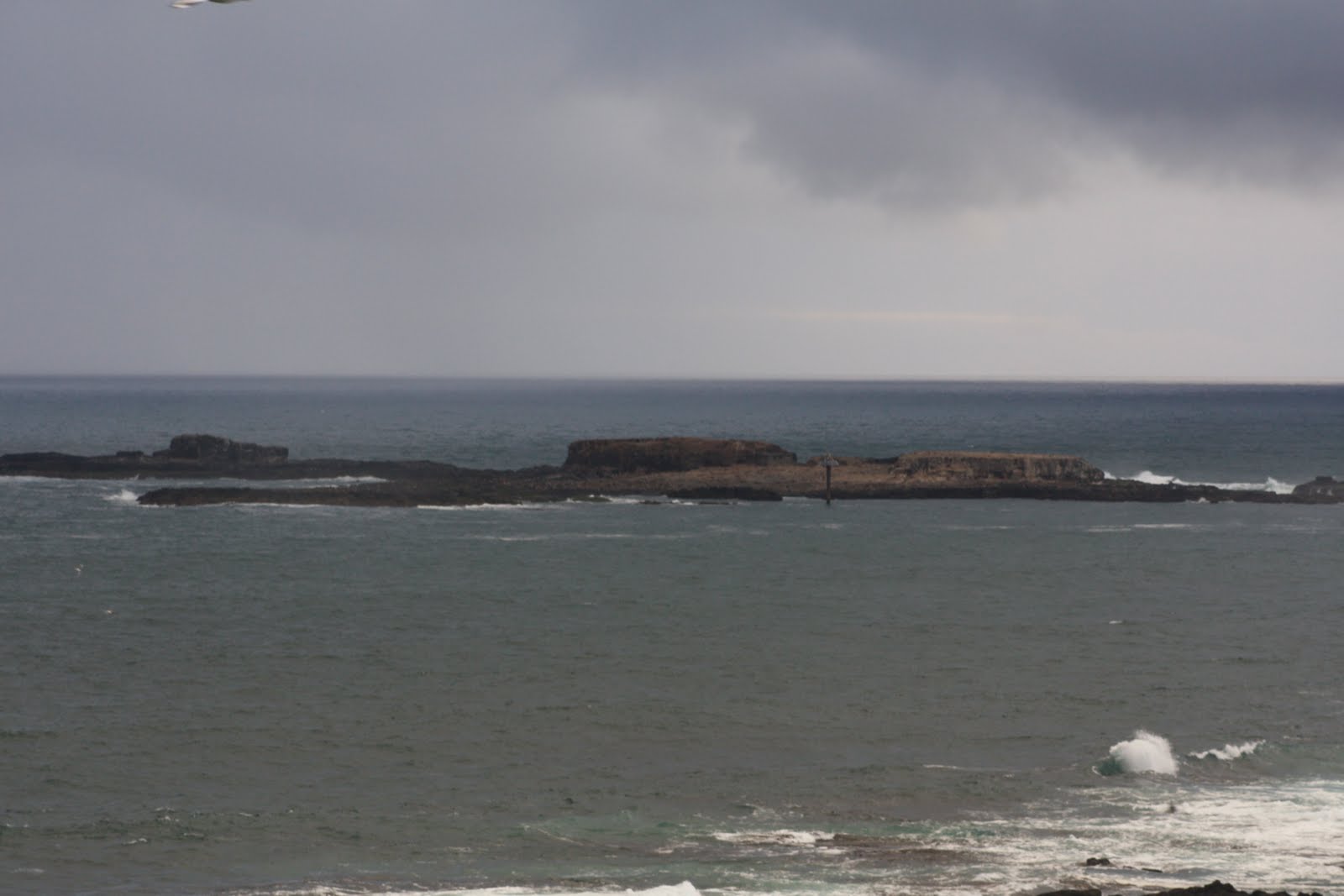
It turns out that the seal colony is on this islet. It's only 1500m from shore, and you might be able to see some of them if you just put $5 into one of the telescopes. The same telescopes that you put $1 into everywhere else in Australia.


But The Nobbies are also home to a huge colony of seagulls. Did I mention it was spring?


I'd never seen seagull chicks before. This gull was happily nesting right next to the boardwalk. Perhaps this shouldn't have surprised me, given how assertive seagulls are, but it did.


From the parking area on the north side, we could see the sheltered waters of Westernport Bay.


And at the end of the boardwalk, we could see the south coast of Phillip Island, and the wild waves of Bass Strait.


What a contrast! But it is in Bass Strait that the Fairy Penguins Little Penguins spend a couple of days at a time fishing. Then they come in on the southern beaches and waddle up to their burrows. Photography is prohibited as it hurts the penguins' eyes, but you can watch footage at the Penguin Island site.
I found the Penguin Parade quite magical. For a long time there are no penguins, just the ebb and flow of waves on the sand. Then a wave recedes and magically, there are a dozen little silvery bodies standing where you thought there was only foam. They march together, rather timid on the exposed sand but confident once into the dunes, to their burrows. There are penguin highways through the grass and under the boardwalks, and the birds make extraordinary noises to each other. Each bird has a unique call, and it is by this call that they identify themselves to their spouses, who at this time are already incubating eggs in the hundreds of burrows. I'm grateful that sometimes, we get it right with our wildlife.

Friday, October 22, 2010

Melbourne Botanical Gardens

I knew I wanted to see the Melbourne Botanical Gardens, but didn't realise that I would feel like I hadn't left Sydney!

Bits of the Royal Botanical Gardens, and Centennial Park and Vaucluse House, look pretty much like this. Apparently there was a peculiarly Antipodean muddling of the Picturesque and Gardenesque, and here you have it: meandering lakes and shrubberies, but specimen trees and elaborate borders included as well. (No, I can't quite conceptualise how people muddled Gardenesque and Picturesque together, but they did. It seems to be an Australian habit to pick the bits they like out of disparate ideas and mix them all together without regard for consistency.)

The garden, like the Sydney equivalent, is a lovely place to wander through but not so easy to photograph. Some of the borders were lovely:


How about these contrasts in texture and colour?


I took about half a dozen photos of Echium candicans, with stunning electric-blue spires of flowers. We wants it, my precious, we wants it! And I've seen Echiums growing in Sydney, so I know they can cope with our humidity. Now it's a matter of finding the plain Echium candicans, rather than a cultivar.


With the recent drought the Gardens staff have focussed more on water-wise plantings. I particularly admired this bed, on a steep bank overlooking the Yarra. I would love to know what the red-and-white bulbs are; I don't think they are tulips.


I definitely wanted to see the redesigned "Guilfoyle's Volcano". The famous director and designer of the Gardens had a reservoir built and designed a "volcano" garden for it as a kind of folly. The introduction of town water for irrigation led to the old reservoir being ignored for years, but recent drought has prompted a redesign. The new garden is very modern in style but still reads like a folly because it is so different from its surroundings. I loved it but felt I couldn't do it justice in photos. It is planted with thousands of different cacti and succulents in great drifts, and the red rock-mulch makes it quite startling on a grey Melbourne afternoon. The number and size of Golden Barrel cacti was also quite startling, and how often do you see a mass planting of Jelly Beans?


The reservoir holds water again, this time collected from local stormwater, rather than pumped in from the Yarra as it was originally. The surface has a number of circular planting-rafts floating on it, but they were empty. Enlarge the photo for a better look at the clever fencing. The boardwalk is a double-spiral around the top of the reservoir.

Unfortunately, I had somehow missed out on hearing about the other Botanical Gardens, at Cranbourne. I saw it as we headed for Phillip Island, but there was no time to investigate it. Next time...