Yesterday, the boys came rushing in to tell me that there was a mouse in the chook food bucket. The bucket was nearly empty and the poor mouse, not a very large one, was unable to jump out. I roused on the boys for leaving the lid off overnight and took the bucket outside.
There we were as I tipped the bucket slowly sideways to let the mouse out: the Geek, the Twig, the Sprig and the chooks wandering near us. The mouse finally leapt out and bolted between my husband's feet, looking for safety in the grass nearby.
But too late! One of our chooks saw the movement and tore after it. To my surprise, she was able to snatch the mouse up in her beak -- it shrieked! -- and then all the chooks were after her. The poor mouse was dropped and snatched up several times before one of the girls triumphantly carried off the now-lifeless body to a corner of the back yard.
I had no idea chickens would attack an animal as big as a mouse!
Showing posts with label Wildlife. Show all posts
Showing posts with label Wildlife. Show all posts
Sunday, August 12, 2012

Sunday, November 27, 2011
Preparing for a Bog Garden
We had only 45 minutes of sunshine in Sydney last week. The local rain gauge says we've had 137mm since the start of the month, more than one-and-a-half times the average. That's La Nina for you!
There's a new garden bed between my newly-concreted driveway and path. Well, there would be if I had added any soil to it -- it's just clay and a few weeds. And 137mm of rainwater.

Our builders came back this week to deal with a few issues and The Geek was solemnly warned that this reservoir so close to the house was a Bad Thing, because the house is downslope. Initial excavations today have revealed some thin concrete inside the bed, which may have reduced the speed at which this water drains into the subsoil. I am not hopeful that we can keep the area dry in the long term.

My plan is to create a dished depression in the middle of the triangle, add some leaf-litter and shelter, then plant the whole area with bog plants. I imagine clumps of sedges at each corner as markers for people using the paths. Nobody wants to fall into a bog, garden or not!
The Australian Association of Bush Regenerators has put together a list of Frog-friendly Sydney plants here. I am particularly interested in these ones, as they are known to grow in my area:
If you are interested in encouraging frogs into your garden, I can recommend the following websites:
There's a new garden bed between my newly-concreted driveway and path. Well, there would be if I had added any soil to it -- it's just clay and a few weeds. And 137mm of rainwater.

Our builders came back this week to deal with a few issues and The Geek was solemnly warned that this reservoir so close to the house was a Bad Thing, because the house is downslope. Initial excavations today have revealed some thin concrete inside the bed, which may have reduced the speed at which this water drains into the subsoil. I am not hopeful that we can keep the area dry in the long term.

This water is runoff from the driveway. We are going to have a recurring problem here. The subsoil is clay and if the soil is saturated, the excess water has nowhere to go. If I were to mound up a garden bed on top of it, either the soil would wash away or the plants would drown. I am going to have to allow for temporary flooding but want the excess water to be taken up by plants. Now how does a frog habitat sound?
What do frogs need?
- Most common frogs don't require standing water; temporary ponds are enough
- If there is a pond, it should have gently sloping sides as not all frogs can climb
- Frogs need plenty of cover: shrubs, logs, tussock plants and so on
- They frequent moist, shaded areas and can roam some distance from water sources
What do tadpoles need?
- Tadpoles do need some water
- Tadpoles need water that isn't entirely shaded -- they eat algae, which grows in sunlit water
- Tadpoles need oxygenated water. Duckweed and Azolla tend to decrease oxygen levels and will need to be removed.
- Tadpoles also eat the fungi and bacteria from decomposing plants
- Tadpoles are sensitive to manure
- Not to have frogs singing under their bedroom windows. This location is away from our bedrooms and not too close to the neighbours' bedrooms either.
My plan is to create a dished depression in the middle of the triangle, add some leaf-litter and shelter, then plant the whole area with bog plants. I imagine clumps of sedges at each corner as markers for people using the paths. Nobody wants to fall into a bog, garden or not!
The Australian Association of Bush Regenerators has put together a list of Frog-friendly Sydney plants here. I am particularly interested in these ones, as they are known to grow in my area:
- Hydrocotyle peduncularis (Native Pennywort)
- Persicaria decipiens (Knotweed)
- Knobby Club-Rush (Isolepis nodosa)
- Common Rush (Juncus usitatus)
- Mat Rush (Lomandra longifolia)
If you are interested in encouraging frogs into your garden, I can recommend the following websites:
- FATS, the Frog And Tadpole Study Group of NSW
- The Frogs Australia Network has plenty of information for Australians about frogs.
- The Backyard Buddies programme helps children identify andd conserve local wildlife of all sizes.
Thursday, December 30, 2010
New Year Spiders
If you're arachnophobic, I must warn you that this post is all about spiders and includes photos.
This year's rain has caused insect numbers to jump, and our beloved spiders are mopping them up for us all over the back yard. Here are a few I found to share with you. All the spiders seem to be from the same family, the Araneidae.
First is the St Andrew's Cross Spider (Argiope keyserlingi), which sits in its web with its legs paired to make a St Andrew's Cross. Pity this one's web runs across the doorway of my garden shed! I have been crouching to go under the web.

Here is its underside, with another view of its neatly-wrapped lunch.

When I first saw this 5mm creature, I thought it was a beetle of some kind (apologies for the photo quality). It was only when I enlarged the photo that I could see the head and front legs. It is possibly a Gasteracantha.

I call this a stick spider, for obvious reasons, but haven't been able to identify it.

Our most common spider is the Garden Orb Weaver (Eriophora spp.), which puts up a new web after dark. We have heaps of them about this year; many more than usual. I suppose that means that we have many more night-flying insects than normal. This one was sleeping the summer day away in a secluded leaf. Doesn't it look peaceful?

This year's rain has caused insect numbers to jump, and our beloved spiders are mopping them up for us all over the back yard. Here are a few I found to share with you. All the spiders seem to be from the same family, the Araneidae.
First is the St Andrew's Cross Spider (Argiope keyserlingi), which sits in its web with its legs paired to make a St Andrew's Cross. Pity this one's web runs across the doorway of my garden shed! I have been crouching to go under the web.

Here is its underside, with another view of its neatly-wrapped lunch.

When I first saw this 5mm creature, I thought it was a beetle of some kind (apologies for the photo quality). It was only when I enlarged the photo that I could see the head and front legs. It is possibly a Gasteracantha.

I call this a stick spider, for obvious reasons, but haven't been able to identify it.

Our most common spider is the Garden Orb Weaver (Eriophora spp.), which puts up a new web after dark. We have heaps of them about this year; many more than usual. I suppose that means that we have many more night-flying insects than normal. This one was sleeping the summer day away in a secluded leaf. Doesn't it look peaceful?

If you wish to live and thrive
Let the spider run alive.
Best wishes to everyone for the New Year!
Let the spider run alive.
Best wishes to everyone for the New Year!
Friday, November 12, 2010
Phillip and Churchill Islands
Like most tourists to Melbourne, I was very keen to see the Fairy Penguins at Phillip Island, and somewhat daunted to discover how far we had to drive to get there and at how large the island was. It's a pleasant drive around Westernport Bay, however, and we can recommend the Sorrento Fisherman's Co-op for good fish and chips. They also feed the local pelicans at lunch time.
But as the penguins come in after sunset, what do you do beforehand? We spent the afternoon at Churchill Island, nestled on the Westernport Bay side of Phillip Island. It's a heritage farm these days, part historic site, part farm education centre, part nature reserve and part petting zoo. The kids had a cart ride, and saw some shearing and blacksmithing. The sheepdogs showed off their training (apparently a fully-trained sheepdog costs about $5000) by rounding up first sheep, then a pair of turkeys!
And as it was spring, love was in the air. Portrait of a young man trying to impress a young lady:

A number of wallabies live in a large enclosure, and we told there was a mother with her joey, but that she was very shy and we'd be lucky to see it.

The caretaker was quite thrilled when we came upon the mother in an open area and the joey was not only awake, but peeping out of the pouch in the classic manner!

The historic house and its outbuildings and garden fascinated me more than the children, but we all loved this pump-activated fountain made out of old tractor seats.

In the late afternoon we drove down to The Nobbies, the extreme western end of Phillip Island, to visit a new Seal Centre. It would be good to see some seals while we were here, I thought. We went into the Centre, full of interesting information about Australian Fur Seals -- but where were the animals?
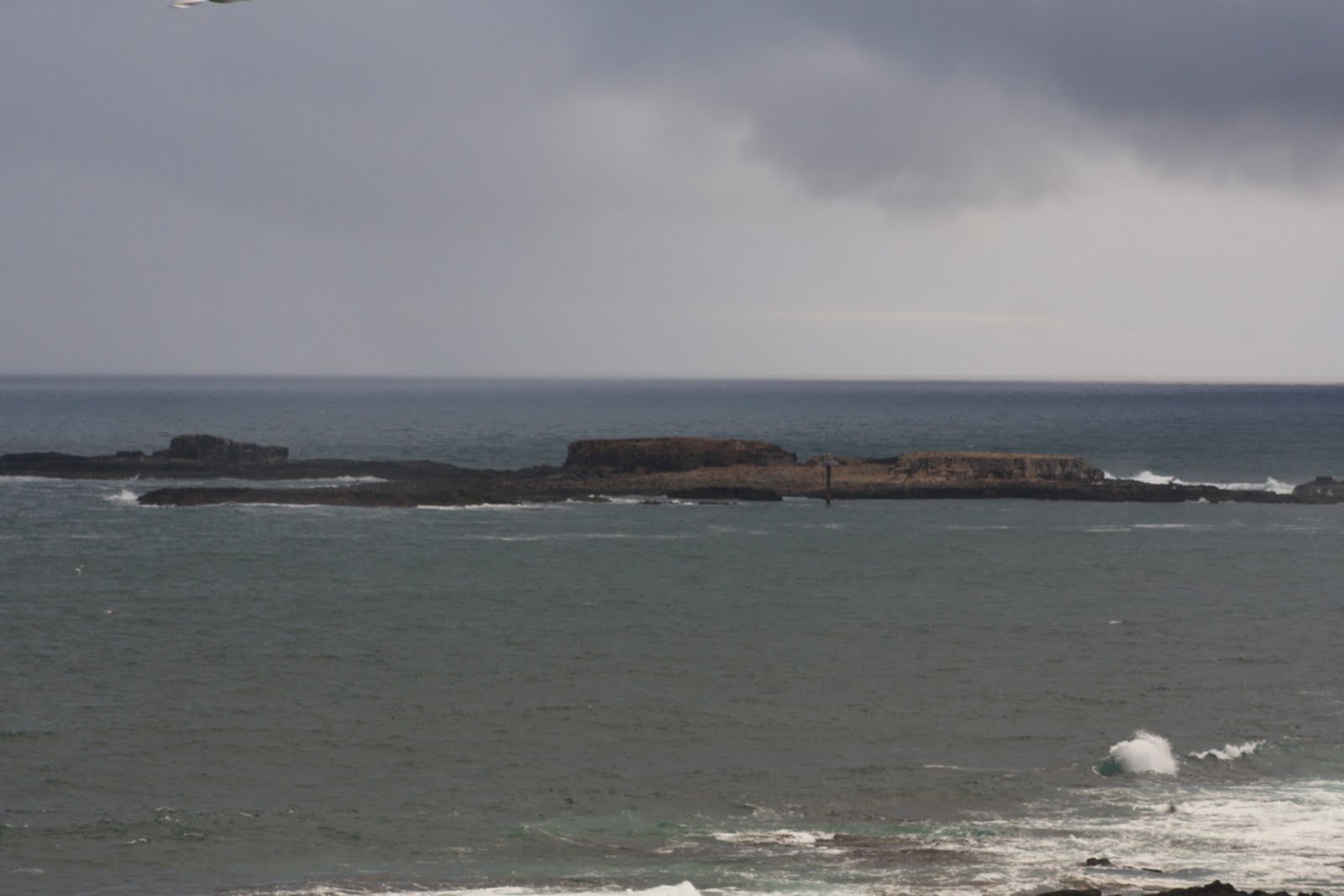
It turns out that the seal colony is on this islet. It's only 1500m from shore, and you might be able to see some of them if you just put $5 into one of the telescopes. The same telescopes that you put $1 into everywhere else in Australia.

But The Nobbies are also home to a huge colony of seagulls. Did I mention it was spring?

I'd never seen seagull chicks before. This gull was happily nesting right next to the boardwalk. Perhaps this shouldn't have surprised me, given how assertive seagulls are, but it did.

From the parking area on the north side, we could see the sheltered waters of Westernport Bay.

And at the end of the boardwalk, we could see the south coast of Phillip Island, and the wild waves of Bass Strait.

What a contrast! But it is in Bass Strait that theFairy Penguins Little Penguins spend a couple of days at a time fishing. Then they come in on the southern beaches and waddle up to their burrows. Photography is prohibited as it hurts the penguins' eyes, but you can watch footage at the Penguin Island site.
I found the Penguin Parade quite magical. For a long time there are no penguins, just the ebb and flow of waves on the sand. Then a wave recedes and magically, there are a dozen little silvery bodies standing where you thought there was only foam. They march together, rather timid on the exposed sand but confident once into the dunes, to their burrows. There are penguin highways through the grass and under the boardwalks, and the birds make extraordinary noises to each other. Each bird has a unique call, and it is by this call that they identify themselves to their spouses, who at this time are already incubating eggs in the hundreds of burrows. I'm grateful that sometimes, we get it right with our wildlife.
But as the penguins come in after sunset, what do you do beforehand? We spent the afternoon at Churchill Island, nestled on the Westernport Bay side of Phillip Island. It's a heritage farm these days, part historic site, part farm education centre, part nature reserve and part petting zoo. The kids had a cart ride, and saw some shearing and blacksmithing. The sheepdogs showed off their training (apparently a fully-trained sheepdog costs about $5000) by rounding up first sheep, then a pair of turkeys!
And as it was spring, love was in the air. Portrait of a young man trying to impress a young lady:

A number of wallabies live in a large enclosure, and we told there was a mother with her joey, but that she was very shy and we'd be lucky to see it.

The caretaker was quite thrilled when we came upon the mother in an open area and the joey was not only awake, but peeping out of the pouch in the classic manner!

The historic house and its outbuildings and garden fascinated me more than the children, but we all loved this pump-activated fountain made out of old tractor seats.

In the late afternoon we drove down to The Nobbies, the extreme western end of Phillip Island, to visit a new Seal Centre. It would be good to see some seals while we were here, I thought. We went into the Centre, full of interesting information about Australian Fur Seals -- but where were the animals?
It turns out that the seal colony is on this islet. It's only 1500m from shore, and you might be able to see some of them if you just put $5 into one of the telescopes. The same telescopes that you put $1 into everywhere else in Australia.
But The Nobbies are also home to a huge colony of seagulls. Did I mention it was spring?

I'd never seen seagull chicks before. This gull was happily nesting right next to the boardwalk. Perhaps this shouldn't have surprised me, given how assertive seagulls are, but it did.

From the parking area on the north side, we could see the sheltered waters of Westernport Bay.

And at the end of the boardwalk, we could see the south coast of Phillip Island, and the wild waves of Bass Strait.

What a contrast! But it is in Bass Strait that the
I found the Penguin Parade quite magical. For a long time there are no penguins, just the ebb and flow of waves on the sand. Then a wave recedes and magically, there are a dozen little silvery bodies standing where you thought there was only foam. They march together, rather timid on the exposed sand but confident once into the dunes, to their burrows. There are penguin highways through the grass and under the boardwalks, and the birds make extraordinary noises to each other. Each bird has a unique call, and it is by this call that they identify themselves to their spouses, who at this time are already incubating eggs in the hundreds of burrows. I'm grateful that sometimes, we get it right with our wildlife.
Monday, October 4, 2010
Melbourne Zoo
This isn't a very garden-oriented post, but everyone likes animals, don't they?
Here is Melbourne Zoo's newest arrival. He's famous, but unnamed as yet.

It's funny to see a tiny elephant zooming around and generally acting rather like a human toddler. Here is Mali, a four month old elephant calf. She is rather more sedate than the little boy.

There are public toilets, and there are very public toilets. This is one of a group scattered around the premises, asking who had the most unusual poo at the zoo. The boys, of course, thought this was the height of wit.

The orangutan play compound is a nice example of an adventure playground. I am sure there are similar playgrounds for human children!

I didn't find the Japanese garden very satisfying. It seems very busy, with many different plants; the gardens I saw in Japan had a more restricted palette. And the deer-scarer wasn't working!

This was the best shot I could get of the dryland garden at the entrance to the Australian animals exhibit. I have not done it justice. I have not been able to identify the yellow-flowering plant at right. The big grey one in the foreground is an Eremophila with lavender-blue flowers, most likely E. nivea. I am not sure how these plants will survive in the damp Melbourne climate! The grass-trees along the fence will be all right.

This sculpture includes lines from our best-known patriotic poem, "Core of my Heart", by Dorothea Mackellar.

One of our better-known animals, doing what he does best. I must admit I felt like doing the same by the time I encountered him at the end of the day. You can see the size of his claws, which is one of the reasons we don't tend to cuddle koalas very often. That said, at least he isn't carnivorous or aggressive like his cousin the drop-bear.

Here is Melbourne Zoo's newest arrival. He's famous, but unnamed as yet.

It's funny to see a tiny elephant zooming around and generally acting rather like a human toddler. Here is Mali, a four month old elephant calf. She is rather more sedate than the little boy.

There are public toilets, and there are very public toilets. This is one of a group scattered around the premises, asking who had the most unusual poo at the zoo. The boys, of course, thought this was the height of wit.

The orangutan play compound is a nice example of an adventure playground. I am sure there are similar playgrounds for human children!

I didn't find the Japanese garden very satisfying. It seems very busy, with many different plants; the gardens I saw in Japan had a more restricted palette. And the deer-scarer wasn't working!

This was the best shot I could get of the dryland garden at the entrance to the Australian animals exhibit. I have not done it justice. I have not been able to identify the yellow-flowering plant at right. The big grey one in the foreground is an Eremophila with lavender-blue flowers, most likely E. nivea. I am not sure how these plants will survive in the damp Melbourne climate! The grass-trees along the fence will be all right.

This sculpture includes lines from our best-known patriotic poem, "Core of my Heart", by Dorothea Mackellar.

One of our better-known animals, doing what he does best. I must admit I felt like doing the same by the time I encountered him at the end of the day. You can see the size of his claws, which is one of the reasons we don't tend to cuddle koalas very often. That said, at least he isn't carnivorous or aggressive like his cousin the drop-bear.

Monday, May 10, 2010
Our Visit to Glen Innes
 A while ago, we had a family trip to Glen Innes to visit an elderly relative -- isn't it amazing to think of my children having a great-great-uncle? My husband's family come from this area so we took a look at various places that his relatives had lived in (and hunted for graves in the cemetery) as well as doing touristy things like visiting the Standing Stones.
We stayed at a farm again, this time Sharron Park, a little south of Glen Innes.

 The friendly Crosby family gave us rooms in the original part of their farmhouse. I liked their garden, which mixed various textures beautifully. I am not particularly fond of New Zealand Flax, but I loved this balanced arrangement. Below is the view from our window.
When I was exploring the garden the next morning (we arrived after dark), a friendly face greeted me. I think I was a disappointment -- no sugar!

I have to tell you about the silver service breakfast, presented on an array of antique and vintage crockery. Fresh fruit, fruit compote (I particularly liked the family recipe for Dutch Apple), yoghurt, cereals. Then in came the hot course: beef sausages from their own meat, scrambled eggs from their own chooks, and grilled tomato from the vegetable patch. After we had indulged ourselves, we went exploring. A little later in the morning, we went on a tour of the property.

Here are some of the stock: happy Herefords. I was impressed by how well-wooded New England still was; the Riverina has considerably less tree cover.

Our informative tour took us around the farm and included a hunt for a problem in the electric fencing (which fortunately turned out to be a loose wire rather than a break, probably knocked by a bounding kangaroo). At this time of year the cows were all in calf. We also went out into the old stock route which adjoins the property. These days, the stock routes can be leased for grazing. They are reverting to bush a bit now, and are a good place to find kangaroos. We spotted a couple. Here is one, see it?

No? But it's right in the middle!

Here is another relic of the droving days, part of a temporary yard used when two herds were close to each other.

I would love to show you more, but I've been wrestling with Blogger's picture uploader for over a fortnight with this post, and I've had enough. But if you have the chance to tour this beautiful part of NSW, take it.


Sunday, April 25, 2010
Portrait of Autumn

It's my favourite time of year for gardening, so felt a sudden need to buy a few things at Bunnings on Friday. Today I set up a terracotta pot combining Aloe vera and Dichondra argentea. I've admired this Dichondra for some time on Digging and now have it in a combination which I'm happy with. It will live in a sunny spot under our carport roof.
Then I decided to plant my 'Nelly Kelly' blueberry in a big self-watering pot, which had been holding tomato stakes for a while. There was a lot of leaf litter in the bottom of the pot (and perhaps redbacks), so I tipped the pot sideways to clear it. Next thing, something had leapt out of the water reservoir! The frog then sat still in an I'm-not-here fashion, so my children were able to have a look at it too. Given its size, I think it might be a Pobblebonk, rather than the Common Eastern Froglet or Brown Toadlet. I made sure I replaced the pot in roughly the same spot and am hoping that Jeremy Fisher returns to his home. I am also hoping that 'Milkmaid' nasturtiums grow true to type as I've put some seedlings from last year's plants around the blueberry.
Tomorrow, I'm moving my strawberries into the vegie patch and planting the empty trough with sage and thyme. It occurred to me that these plants would probably do better in a cactus mix, so we'll see if that improves their lifespan. I'm good at killing thyme and sage, alas. Then there are a few other vegetable seedlings to transplant, carrots for the Sprig to sow, and a bathroom to paint...
Monday, June 15, 2009
Bird-Watching at Homebush Bay

I love the big skies here -- one of the advantages of living on the edge of the Cumberland Plain. Would you guess you're in the geographic centre of a city of four million people?
Serious, stay-in-a-hide-for-days bird-watching is not on the agenda for us, with two young boys. But nonetheless, we can wander to a bike track a few kilometres away and pop into the bird-hide at the Sydney Olympic Park Bird Refuge. The Geek took both these photos from the hide.

Black-Winged Stilts and Pacific Black Ducks (I think -- a common species, anyway) feeding on the mudflats. In the summer, this area is host to migratory species from Siberia and Central Asia. More details here.
Subscribe to:
Posts (Atom)