Sunday, February 13, 2011

We Are Go for Launch


We have talked to the nice man from the bank, and he was happy to lend us more money. We've signed a contract with Louie, our builder, and he is hoping to start work in a fortnight or so. The last step is looking for interim accommodation. I had hoped to live in during some of the work, but there is going to be a great deal of dust (some of it with lead, given the age of the house) and some asbestos Fibro removal. However, the house next door has fallen vacant and we were able to put a deposit down, so we are hoping that the landlord approves us.

After years of dreaming and planning, it is amazing that in the course of a Saturday, everything could change so quickly!

Sunday, January 9, 2011

Cicada Season

It all started when I saw a plump cicada in a spider's web. I have lived here for 11 years and I didn't know we had Floury Bakers!


But it might not be a Floury Baker, despite the floury look. I went looking, and it turns out that there are 273 species of cicada in Australia, in 38 genera. And with more species than you might expect frequenting Western Sydney! Nonetheless, this species has the Floury Baker habit of standing head downwards on the tree:


They are rather well camouflaged on the greyish trunk of Acacia fimbriata, the Fringe Wattle.


I'm glad to have found them! We don't have Greengrocers (Cyclochila australasiae) as they like big eucalypts. My biggest eucalypt plainly isn't big enough yet.

Our main cicada species is small and quite prolific. This cicada case was found with many others under my Parramatta Wattle. The grass-blade is kikuyu; the case is therefore only 2-3cm long.


I suspect that it belongs to someone like this camera-shy fellow on my Hakea. He's only about 3cm long and really didn't want to be photographed. I've seen this type on my wattles too, so I think he might be a Spotted Wattle Cicada. The coloration is a very dark green.


On the other hand, he might be a Ferny Acacia Cicada, though they don't seem to have a wing-spot.


I'm really not sure, but I feel sorry for my cicadas, whatever species they are. They don't sing in the rain, and it's been raining a lot.

If you want to learn more about cicadas, or try identifying your own, have a look at Lindsay Popple's fascinating and detailed site.

Thursday, December 30, 2010

New Year Spiders

If you're arachnophobic, I must warn you that this post is all about spiders and includes photos.

This year's rain has caused insect numbers to jump, and our beloved spiders are mopping them up for us all over the back yard. Here are a few I found to share with you. All the spiders seem to be from the same family, the Araneidae.

First is the St Andrew's Cross Spider (Argiope keyserlingi), which sits in its web with its legs paired to make a St Andrew's Cross. Pity this one's web runs across the doorway of my garden shed! I have been crouching to go under the web.


Here is its underside, with another view of its neatly-wrapped lunch.


When I first saw this 5mm creature, I thought it was a beetle of some kind (apologies for the photo quality). It was only when I enlarged the photo that I could see the head and front legs. It is possibly a Gasteracantha.


I call this a stick spider, for obvious reasons, but haven't been able to identify it.


Our most common spider is the Garden Orb Weaver (Eriophora spp.), which puts up a new web after dark. We have heaps of them about this year; many more than usual. I suppose that means that we have many more night-flying insects than normal. This one was sleeping the summer day away in a secluded leaf. Doesn't it look peaceful?


If you wish to live and thrive
Let the spider run alive.

Best wishes to everyone for the New Year!

Sunday, December 26, 2010

Merry Christmas!


CHRISTMAS BUSH FOR HIS ADORNING

All the bells are gaily ringing,
Birds in every tree are singing;
Let us in the golden weather,
Gather Christmas Bush together.

Christ is born! The angels thunder,
Thru’ the Heavens their tale of wonder,
While we pluck for His adorning
Christmas Bush this hallowed morning.

Christ has conquered Evil’s power
Hear the bells rock every tower
Birds and beasts lift up their voices,
Freed at last the world rejoices.

Onward with triumphant chorus,
Following the road before us,
Singing thru’ the golden weather,
Gath’ring Christmas Bush together.

Merry Christmas, everyone! I hope you have some time to play in your back yards.

Sunday, November 28, 2010

But in my garden?

While I have been regaling you with photos of Victoria, not a lot has happened here in the garden. It has proved difficult to plant warm-weather crops as the last few months in Sydney have been extraordinarily wet; in fact it's raining right now.


Month
Average (mm)
Actual (mm)
September52.769.8
October
64.985.2
November72.9108.0 (so far)

This is due to a fairly strong La Nina effect which is expected to remain all summer. Our summers are when we receive most rainfall anyway, but we'll probably have longer rainy periods rather than storms. I will also be expecting more moderate temperatures. While that's good for the vegetable garden, the humidity won't lift so often (generally the humidity drops when we get over about 30C), which tends to mean problems with mildew.

The trip to Melbourne, enjoyable as it was, put a hole in my vegetable planting programme. Since then, it's been hard to find time when the soil is dry enough to allow planting. This weekend, fortunately, gave me both moist (not puggy) soil and time. And now my new plantings are being watered in!

Yesterday, in went my six 'Brandywine' tomato seedlings. I am hoping that temperatures will stay cool long enough for them to grow and set fruit; they should have been in the garden at least a month ago! I am planning a second planting of 'Brandywine' for autumn tomatoes -- in fact, I should plant the seeds this afternoon so that they fruit in March.

The tomatoes are now surrounded by basil, 'Mini' cabbages, 'Flame' lettuce and some 'Mini White' cucumbers, and a row of 'Stringless Pioneer' beans.

Today I planted a block of Sweet Corn 'True Gold' underplanted with Cucumber 'Lebanese Mini Muncher' and 'Sugar Baby' watermelons.

Yesterday, I also put in my heirloom beetroot seedlings, and radish 'French Breakfast' near the bolting Florence fennel and 'Tuscan Black' kale. Found that my leeks had survived, which was rather a surprise. They are sheltered by a sorrel clump and a bolting parsnip, and so should cope when it gets hotter.

My quince tree is laden with small quinces. I need remove a lot of them, then bag the rest against fruit fly. Underneath it, however, are some impressive volunteer tomatoes, which also need bagging. I hope I don't damage too many of them!

By all reasonable measures (that is, non-calendar ones), it's summer:
  • The jacarandas across Sydney have passed their peak of bloom
  • Blowflies and mosquitoes have appeared
  • We have heard Greengrocer cicadas in the trees
  • The Ashes have started
  • The air-conditioning at my workplace broke down
  • The shops are full of Christmas things
  • Our Christmas tree went up this afternoon
And I'm off to prepare my Christmas cake fruit right now: it has to macerate in brandy overnight before I bake the cake tomorrow. See you later!

Friday, November 26, 2010

Out of Melbourne

The Geek had only one requirement of our trip to Victoria: we had to go on Puffing Billy! The line winds through the Dandenongs, on the north-eastern edge of Melbourne. Some parts of the trip are through remnant forest: I think these trees are Mountain Ash (Eucalyptus regnans) and underneath are Rough Tree-ferns (Cyathea australis).

For some reason the camera filled up with an excessive number of train photos.

Though it was interesting to see the cinders being cleaned out of the box. Old books will often refer to cinder paths, so I presume this is what is meant. The pieces of unburnt coal are a bit coarser than the kind of gravel you see on paths.

My husband is not entirely lost to the joys of nature and took these photos of Waratahs for me (I was too short). I am guessing from the location and size that these garden subjects are probably 'Shady Lady Pink'.


The rich chestnut soil of the Dandenongs was like nothing I've seen anywhere before. Except possibly clinging to brushed potatoes!

Then we drove across northern Melbourne to Ballarat. Now it was the chance for our history enthusiast, the Twig, to enjoy himself to the utmost.

Yes, we did find gold. Some.

Our history fiend was wild again when we visited the site of the Eureka Stockade the following day. Click on the photo to read the famous oath taken by the diggers.

This memorial was erected in 1923 on the site of the stockade.

I was impressed with the gracious wording of the plaque; too often Australian history is seen as a war between "goodies" and "baddies". Black armbands and white blindfolds at twenty paces!

We can also highly recommend Eureka Street Fish & Chips, just down the road from the stockade memorial. After lunch, however, we had to head for Tullamarine. The Geek's iPhone, however, wasn't quite up to the task of getting us there...

We did eventually make it onto the plane, rather than under it.

And so ended our trip to Melbourne.

Friday, November 12, 2010

Phillip and Churchill Islands

Like most tourists to Melbourne, I was very keen to see the Fairy Penguins at Phillip Island, and somewhat daunted to discover how far we had to drive to get there and at how large the island was. It's a pleasant drive around Westernport Bay, however, and we can recommend the Sorrento Fisherman's Co-op for good fish and chips. They also feed the local pelicans at lunch time.

But as the penguins come in after sunset, what do you do beforehand? We spent the afternoon at Churchill Island, nestled on the Westernport Bay side of Phillip Island. It's a heritage farm these days, part historic site, part farm education centre, part nature reserve and part petting zoo. The kids had a cart ride, and saw some shearing and blacksmithing. The sheepdogs showed off their training (apparently a fully-trained sheepdog costs about $5000) by rounding up first sheep, then a pair of turkeys!

And as it was spring, love was in the air. Portrait of a young man trying to impress a young lady:


A number of wallabies live in a large enclosure, and we told there was a mother with her joey, but that she was very shy and we'd be lucky to see it.


The caretaker was quite thrilled when we came upon the mother in an open area and the joey was not only awake, but peeping out of the pouch in the classic manner!


The historic house and its outbuildings and garden fascinated me more than the children, but we all loved this pump-activated fountain made out of old tractor seats.


In the late afternoon we drove down to The Nobbies, the extreme western end of Phillip Island, to visit a new Seal Centre. It would be good to see some seals while we were here, I thought. We went into the Centre, full of interesting information about Australian Fur Seals -- but where were the animals?

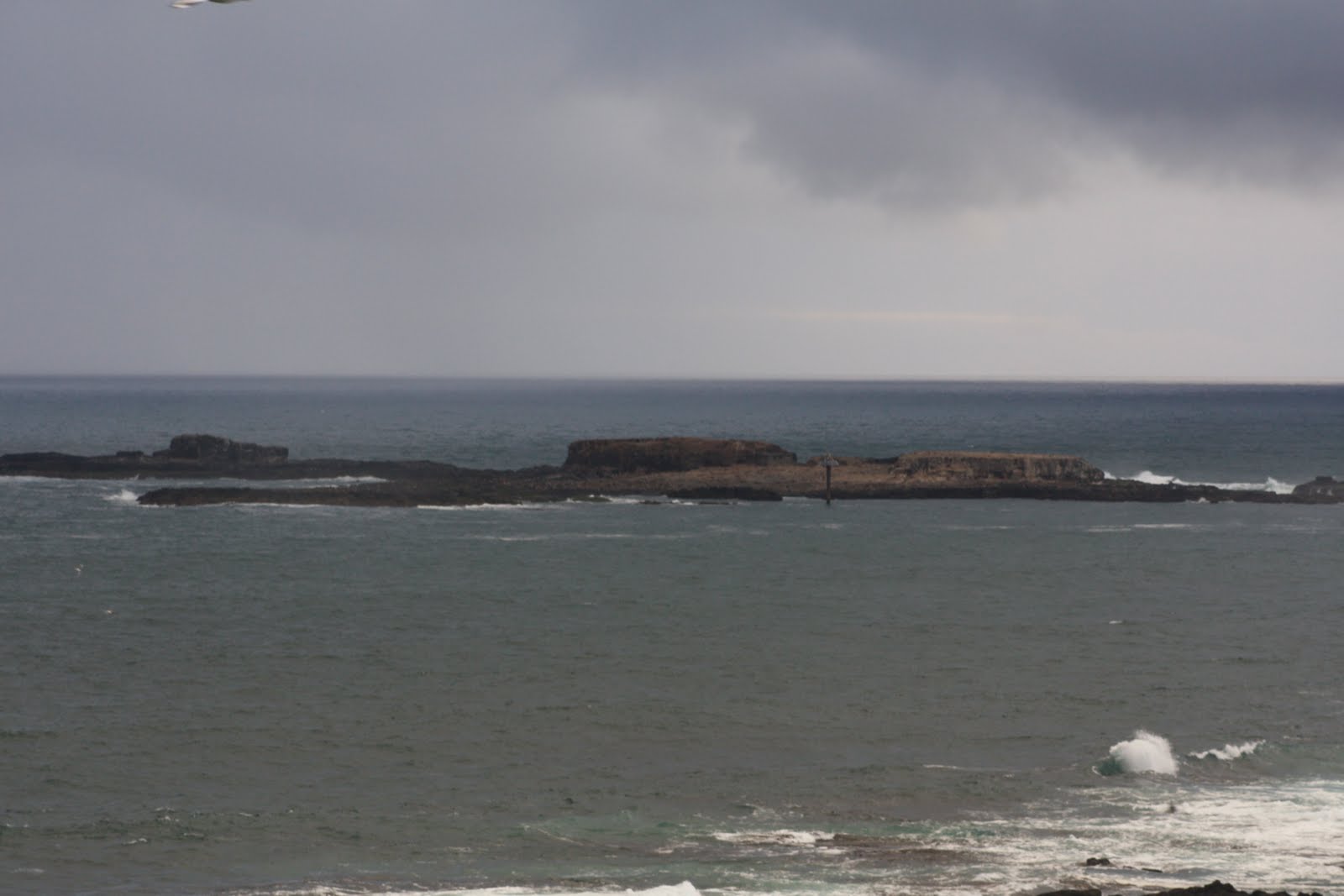
It turns out that the seal colony is on this islet. It's only 1500m from shore, and you might be able to see some of them if you just put $5 into one of the telescopes. The same telescopes that you put $1 into everywhere else in Australia.


But The Nobbies are also home to a huge colony of seagulls. Did I mention it was spring?


I'd never seen seagull chicks before. This gull was happily nesting right next to the boardwalk. Perhaps this shouldn't have surprised me, given how assertive seagulls are, but it did.


From the parking area on the north side, we could see the sheltered waters of Westernport Bay.


And at the end of the boardwalk, we could see the south coast of Phillip Island, and the wild waves of Bass Strait.


What a contrast! But it is in Bass Strait that the Fairy Penguins Little Penguins spend a couple of days at a time fishing. Then they come in on the southern beaches and waddle up to their burrows. Photography is prohibited as it hurts the penguins' eyes, but you can watch footage at the Penguin Island site.
I found the Penguin Parade quite magical. For a long time there are no penguins, just the ebb and flow of waves on the sand. Then a wave recedes and magically, there are a dozen little silvery bodies standing where you thought there was only foam. They march together, rather timid on the exposed sand but confident once into the dunes, to their burrows. There are penguin highways through the grass and under the boardwalks, and the birds make extraordinary noises to each other. Each bird has a unique call, and it is by this call that they identify themselves to their spouses, who at this time are already incubating eggs in the hundreds of burrows. I'm grateful that sometimes, we get it right with our wildlife.